Warsaw
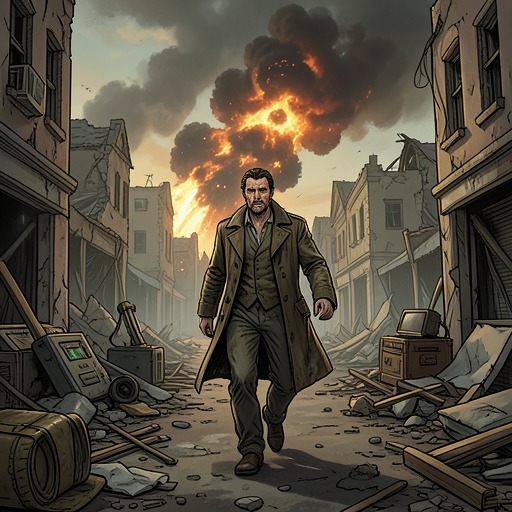
The Old AxolotlWarsaw is the city placed under an announced deadline on the day of the apocalypse, but the crisis reaches Bartek through an unlikely chain of ordinary urban disruptions: a broken washing machine, a flooded wall, and a building-wide power failure. The city’s decisive significance lies in this convergence of catastrophic threat and mundane infrastructure. It is the threatened target in a news alert, and the place where mechanical accident alters who is exposed to the disaster.
The threatened city
Before the sky collapsed, Bartek’s group had planned to meet for lunch at a shopping mall. Nobody in the IT department could explain what was happening when the news arrived. Bartek logged on to gazeta.pl and saw a bold red headline announcing that a neutron wave would hit Warsaw at 19:54; the site then crashed and displayed Error 404. The alert gives the city a precise, ominous deadline, while the abrupt loss of the news site leaves its warning without further explanation.
An accident that changes Bartek’s route
Bartek’s absence from the mall is tied to his reputation as a handyman. His upstairs neighbor’s jolting washing machine had smashed a hole in her bathroom wall; water flooded the gutted wiring and blew the fuses throughout the building. Because Bartek had long been treated as the resident fixer, he was held up repairing the damage. The narrative presents this mundane mishap as the reason he may have survived: it kept him away from the mall when the apocalypse began, though his survival is itself left uncertain.
The repair took until four o’clock. Although it was his day off, Bartek decided to go to work afterward and catch up on tasks from the previous day. The catastrophe therefore does not simply scatter the group; it redirects Bartek into the company building, giving the city’s everyday routines a role in the story’s account of who is caught where.
The IT basement
Bartek’s workplace includes an IT department in the basement, a cooler space where the Chief sometimes went on stressful days to drink iced coffee with his forehead against a server rack. The basement also held the company’s unused InSoul3 units. The company had purchased an expensive industrial version with high-resolution scanning for clinic and university applications, then abandoned plans to use it as an in-house lie detector after lawyers intervened. The boxes remained neglected in a corner and were being auctioned on Allegro at half price.
On the day Warsaw faced the reported neutron-wave deadline, Bartek opened that equipment and began setting it up while Rytka read the instructions. In this way, the basement connects the city’s immediate emergency to technology left over from a failed corporate plan: an unused system, stored among the ordinary machinery of work, becomes available just as familiar systems of information and daily life begin to fail.